By the International Chess Correspondent — HireChess Magazine
In a tournament that began like any other on the professional circuit, the 2025 SilverOak Rapid Masters delivered one of the most electrifying plot twists modern chess has seen. What was expected to be a routine showcase of elite preparation turned into a gripping underdog story—one that players, fans, and analysts will be discussing for months to come.
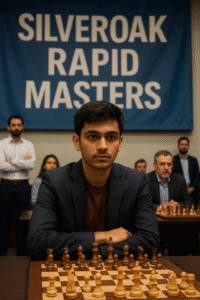
The chess world often celebrates its giants: the seasoned grandmasters with years of experience, deep opening repertoires, and intimidating reputations. But every once in a while, a tournament refuses to follow the script. This year’s SilverOak Rapid Masters proved to be exactly that—thanks to the remarkable rise of a relatively unknown 21-year-old player, Raghav Desai.
A Tournament Full of Giants… and One Rising Star
Hosted in the scenic hillside city of Silvertown, the Rapid Masters traditionally attracts a formidable lineup. This year featured:
- Five 2700+ rated grandmasters
- Multiple continental champions
- A cluster of elite rapid specialists
- And, inserted quietly among them, a single wildcard entry: Raghav Desai, rated just 2314
Few expected his name to appear on the final standings beyond the lower half. Fewer believed he would challenge the top seeds. And absolutely no one predicted he would become the story of the event.
But from the very first round, it was clear Desai hadn’t come to simply gain experience—he had come to compete.
Round-by-Round: The Making of an Upset
Round 1 – A Confident Start
Paired against Grandmaster Marek Sobolev, known for his precision in rapid formats, Desai chose a calm but flexible setup in the English Opening. What impressed spectators wasn’t just his opening play, but his calmness under pressure. In a tense rook endgame, he defended flawlessly, securing a draw that felt like a win for him—and a warning sign for others.
Round 3 – First Shockwave
Desai’s victory over GM Luis Carvalho, one of the event favorites, sent murmurs across the hall. In a dynamic King’s Indian structure, the young challenger launched a kingside pawn storm with surprising accuracy. The attack was direct, fearless, and deeply thematic—qualities usually seen in seasoned rapid specialists.
Carvalho resigned on move 41.
By the end of Day 1, Desai was tied for second place.
Round 5 – The Game Everyone Will Remember
If one game defined Desai’s breakthrough, it was his encounter against the charismatic and heavily favored GM Viktor Grishin.
Opting for the Nimzo-Indian Defense, Desai introduced a novel pawn sacrifice on move 12—an idea previously unseen in elite play. Analysts later discovered that the line had never appeared in any known database. The resulting middlegame was complex, sharp, and volatile.
But Desai navigated it like a veteran, not a newcomer.
His exchange sacrifice on move 25, followed by a cold-blooded king walk, had commentators buzzing. Grishin, visibly unsettled, faltered under time pressure, allowing Desai to convert with enviable technique.
That victory put the 2314-rated wildcard at the top of the leaderboard.
A Growing Crowd and a Rising Tension
By Day 2, the tournament hall felt different. Cameras focused more on Desai. Fans gathered behind his board. His quiet presence—head slightly tilted, fingers tapping the pen—became an unexpected centerpiece of the event.
Even the top seeds took notice.
GM Arpad Kovacs remarked:
“I don’t know much about the kid, but his calculations are clean. Very clean.”
GM Natalia Orlova added:
“He doesn’t hesitate. That’s rare for a young player at this level.”
The pressure, however, continued to mount.
The Penultimate Round – Holding the Line
Round 8 paired Desai against Kovacs, a defensive genius known for grinding opponents into submission. Many predicted that this would be the round where the young wildcard would break.
But despite being slightly worse in a long positional struggle, Desai held immaculately. His fortress setup in a queen-knight endgame demonstrated maturity far beyond his rating.
With the draw secured, Desai maintained half-point lead entering the final round.
Final Round – A Nerve-Wracking Finish
Desai faced International Master Josef Rinkle, a resourceful tactician hungry for a podium finish. The opening was a sharp Sicilian, and both players seemed ready for battle.
Desai played aggressively—perhaps too aggressively. A premature pawn thrust on move 18 allowed Rinkle to seize the initiative. For the first time in the tournament, Desai appeared rattled.
But then came the moment that defined his mental strength.
Instead of collapsing under pressure, he simplified into an opposite-colored bishop endgame where he held firm, defended accurately, and ultimately secured the half-point needed to clinch first place.
With that final draw, the hall erupted in applause.
The wildcard had won the SilverOak Rapid Masters.
A Victory Beyond the Scoreboard
What made Desai’s victory so special wasn’t just the upset itself—it was the style of his play. He showed:
- Sharp tactical awareness
- Unshakable endgame technique
- Willingness to take creative risks
- Consistency under severe psychological pressure
His games did not resemble those of an inexperienced player fumbling through uncharted waters—they looked like the games of a seasoned rapid expert.
Coaches and analysts have begun speculating about the future of this young talent. Some suggest he may soon cross 2500. Others believe he could become a rapid specialist dominating invitational events.
What everyone agrees on, however, is that his SilverOak performance will be remembered.
A Lesson for Every Aspiring Player
Desai’s journey highlights a truth often forgotten in modern chess:
Preparation and rating matter, but courage, discipline, and clarity matter more.
The SilverOak Rapid Masters reminded us that:
- Underdogs can shock the field
- Creativity still finds its place amidst engines and prep
- Rapid chess rewards intuition and nerve
- No grandmaster is unbeatable
It’s a powerful message for developing players—one echoed by training academies like HireChess.com, where structured learning meets competitive sharpening.
Conclusion – A New Star on the Horizon
Raghav Desai’s performance at the 2025 SilverOak Rapid Masters wasn’t just a tournament win—it was a statement. A declaration that the next generation of players is hungry, fearless, and ready to challenge the hierarchy.
For the journalists, the fans, the coaches, and even the seasoned grandmasters, this event was a refreshing reminder of why chess continues to captivate the world.
The board may be 64 squares.
The rules may be centuries old.
But the stories?
They never stop surprising us.